
What you’re really paying for when you hire a home organiser
- 3 days ago
- 6 min read
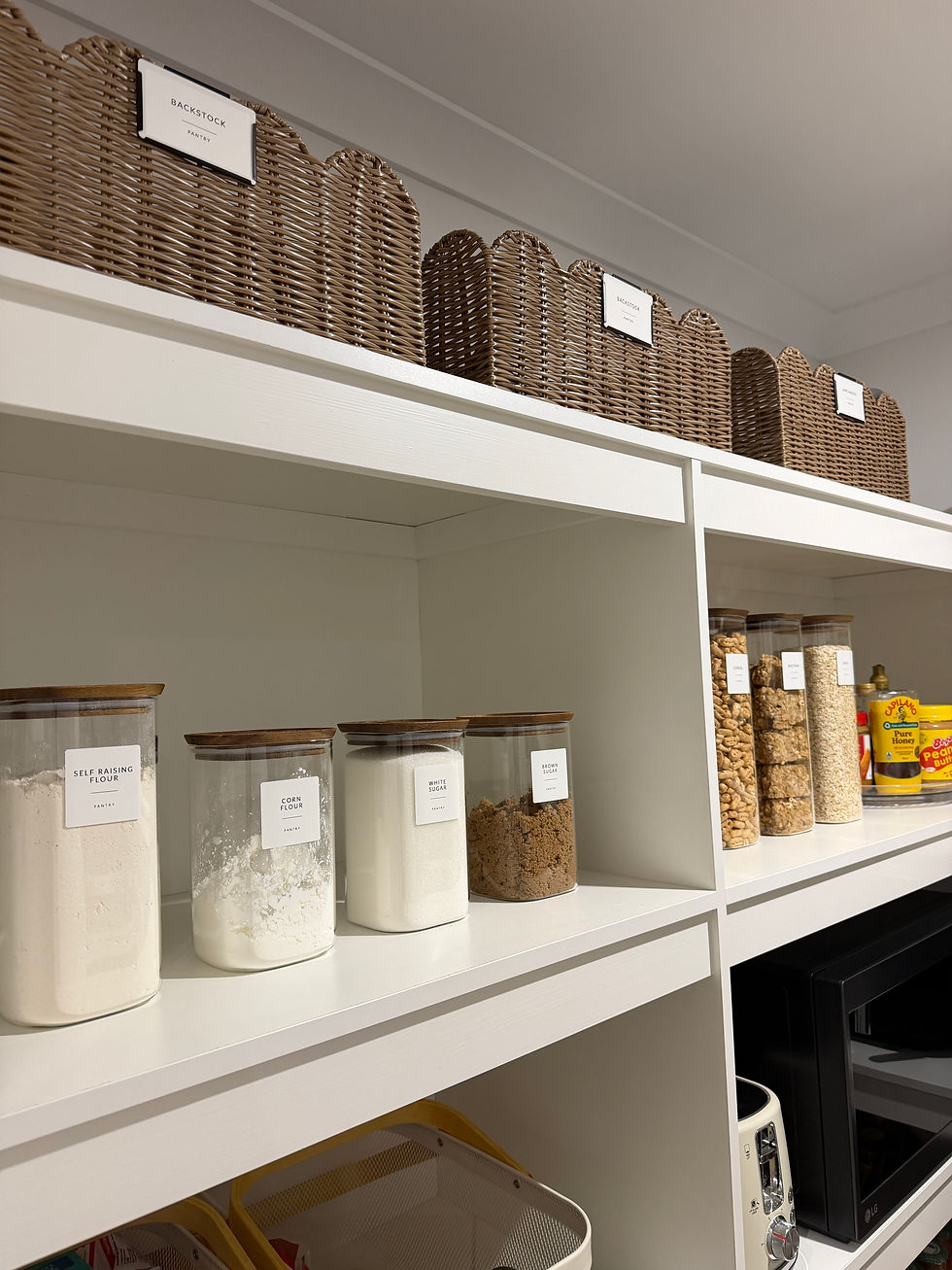
It's easy to look at a home organising service and think you're paying for someone to sort through your cupboards, fold some towels and put everything into containers, but the physical organising is only one part of the service.
A professional home organiser brings much more to the process than a few hours of hands-on help, and a lot of that value comes from the planning, problem-solving and preparation that happens before we even arrive at your home.
Before we even arrive
The consultation
The process starts well before the organising day.
There's time spent talking through what you're hoping to achieve, what isn't working, how you currently use the space, what you need from it and what you'd like to change.
Your preferences, style, inspo images, routines and practical considerations all form part of the conversation because it's about understanding the person behind the space, not just the space itself.
The planning
From there, measurements, photos and everything discussed during the consultation help build a picture of where to start when planning the space.
This is where the problem-solving begins.
What needs to be accessible? What gets used every day? What can be stored away? Which categories make sense together? Is the current layout contributing to the problem?
There can be a lot of decisions to make before a single product is purchased or anything is moved.
The product research
Then there's the research that goes into finding the right products.
Storage isn't chosen simply because it fits or looks nice. It needs to work with the space, the items being stored, the client's habits and, where relevant, their aesthetic preferences and budget.
That can mean comparing different sizes, materials, colours, finishes, prices and brands to find the option that fits.
Sometimes a client's existing products become the starting point for the rest of the design, with additional pieces sourced to complement them so everything feels cohesive.
Even small details can influence the decision.
For example, if a wardrobe has broken coat hangers and hangers regularly end up on the floor, that can tell us something about how the wardrobe is being used. If clothes are being pulled off quickly when getting dressed, delicate or flocked hangers may not be the best choice.
It comes down to finding the balance between how something looks, how it functions and what makes sense for the client.
The design
Every project has a design process behind it.
The goal is to create a space that is functional, considered and beautiful, with the layout, proportions, storage products, finishes, colours and overall flow all considered as part of the plan.
The design needs to work practically for the client while also feeling cohesive within their home.
For projects where aesthetics are a bigger priority, there's naturally more time spent on the design, whether that's sourcing specific finishes, comparing products, creating a more visual direction or refining the finer details of the space.
There may also be back and forth with the client, adjustments to the product selection or changes to the design before everything is finalised, and that's all part of making sure the finished space feels intentional rather than just organised.
The sourcing and shopping
Once the design and product selections are approved, there's still a lot of work involved in actually getting everything ready for the session.
Products need to be ordered, collected or purchased in person, which can mean shopping across multiple stores, organising deliveries and sometimes travelling up to an hour to find a particular product.
And even when shopping in-store, it isn't always as simple as picking the product off the shelf and putting it in the trolley.
There's a level of quality control that happens while shopping too. Products are checked for scratches, chips, cracks, marks, dirt or damage, and anything that doesn't meet the standard for the finished space is left behind.
Functionality is considered too, if a product has a lid, does it close properly? Does it have enough suction? Does it actually work the way it's supposed to? If it's going to be used regularly, will it hold up to that use?
Then there are the smaller aesthetic details that make a difference to the finished space. If we're using wood products, for example, the tone can vary from one piece to the next, which can mean sorting through multiple items in-store to find pieces that are the same or as close as possible in tone rather than ending up with a mix of yellow, ornage, light and dark wood throughout the space.
So even the shopping itself involves much more than buying what's on the list. It's about making sure the products are right for the space, right for the client and right for the system being created.
On the day
Getting everything there
The organising day starts before the actual organising does.
All of the products need to be packed into the car and transported to the client's home, along with labels, cleaning supplies and other equipment needed for the session.
Depending on the project, that can mean fitting a surprisingly large amount of product into the car and making sure everything arrives safely and ready to be used.
The physical reset
The space is pulled apart so it can properly be assessed rather than trying to organise around what's already there.
Items are sorted, categories are refined, expired products are removed and empty packaging is discarded.
Products are washed where needed, particularly when they'll be coming into contact with food, shelves are wiped down, handles are cleaned and the areas being organised are given a proper reset before everything goes back in.
Surfaces are also considered before products are placed, with protective liners or surface protection added where needed, particularly underneath storage products that could scratch or mark a surface over time.
Then there are the smaller details that are easy to overlook but make a difference to how safely and practically a system works.
If a product tends to move or slide every time it is used, anti-slip pads can be added underneath to keep it securely in place.
The organising
Then comes the part most people picture when they think of hiring a professional home organiser.
Items are categorised, sorted and refined, with decisions made about where everything should live.
But even here, there's a lot of strategy involved.
If there's only a handful of items in one category, does that category really need its own container? Could it be combined with another? Is there a better location based on how often it's used? Does something need to be at eye level, or could it be stored higher up?
A space might technically be organised, but if the person using it has to fight the system every time they put something away, it isn't really working.
The finishing touches
Once everything has been given a home, the space is refined.
Products are positioned intentionally, categories are easy to understand and labels are added where they'll be genuinely useful.
Everything is considered as a whole, making sure the space feels cohesive rather than like a collection of individual storage products.
This is where all the planning, research and design that happened beforehand comes together.
So, what are you really paying for?
When you look at a finished space, you see the organised cupboards, the labelled containers and the neatly folded towels.
What you don't necessarily see are the hours behind it.
The consultation, planning, measuring, designing, researching, product comparisons, client communication, revisions, shopping, quality checking, travelling, collecting, ordering, packing and transporting.
Then there's the time spent in the home sorting, decluttering, cleaning, washing products, refining categories, removing rubbish, creating systems and making decisions throughout the day.
And behind all of that is the experience required to bring it together in a way that is both practical and beautiful.
That's what you're really paying for when you hire a professional home organiser.
Not someone to tidy your home for a few hours, but someone to take the entire process off your hands, from working out what isn't working, to designing a better solution, sourcing what's needed and physically putting it all into place.
The finished space is what you see, but the real value is in everything that happens behind it.

Comments